Security in the Age of AI: An Executive Guide to Closing the Gap Between Threat and Remediation
AI is collapsing the time between vulnerability discovery and exploitation. Leaders must close the gap by accelerating remediation, securing the software supply chain, standardizing platforms, and building an operating model that responds at machine speed.


“ The new executive mandate is to close the gap between machine-speed threats and enterprise-speed response. ”
Artificial intelligence is changing both sides of the cybersecurity equation. It is accelerating innovation, software development, and operational productivity. It is also giving attackers the ability to discover vulnerabilities, develop exploits, and scale sophisticated campaigns at unprecedented speed.
For business leaders, this is more than another evolution in the threat landscape. It changes the unit of competition. The question is no longer whether an organization can identify a vulnerability. The question is whether it can move from identification to trusted remediation before an attacker turns that vulnerability into business disruption.
The threat window has collapsed.
For years, many enterprises operated on patching cycles measured in weeks or months. That model was already strained by cloud adoption, expanding application estates, unsupported open-source dependencies, overstretched teams, and fragmented infrastructure. AI is now compressing the time between vulnerability discovery and exploitation to days and, in some cases, hours.
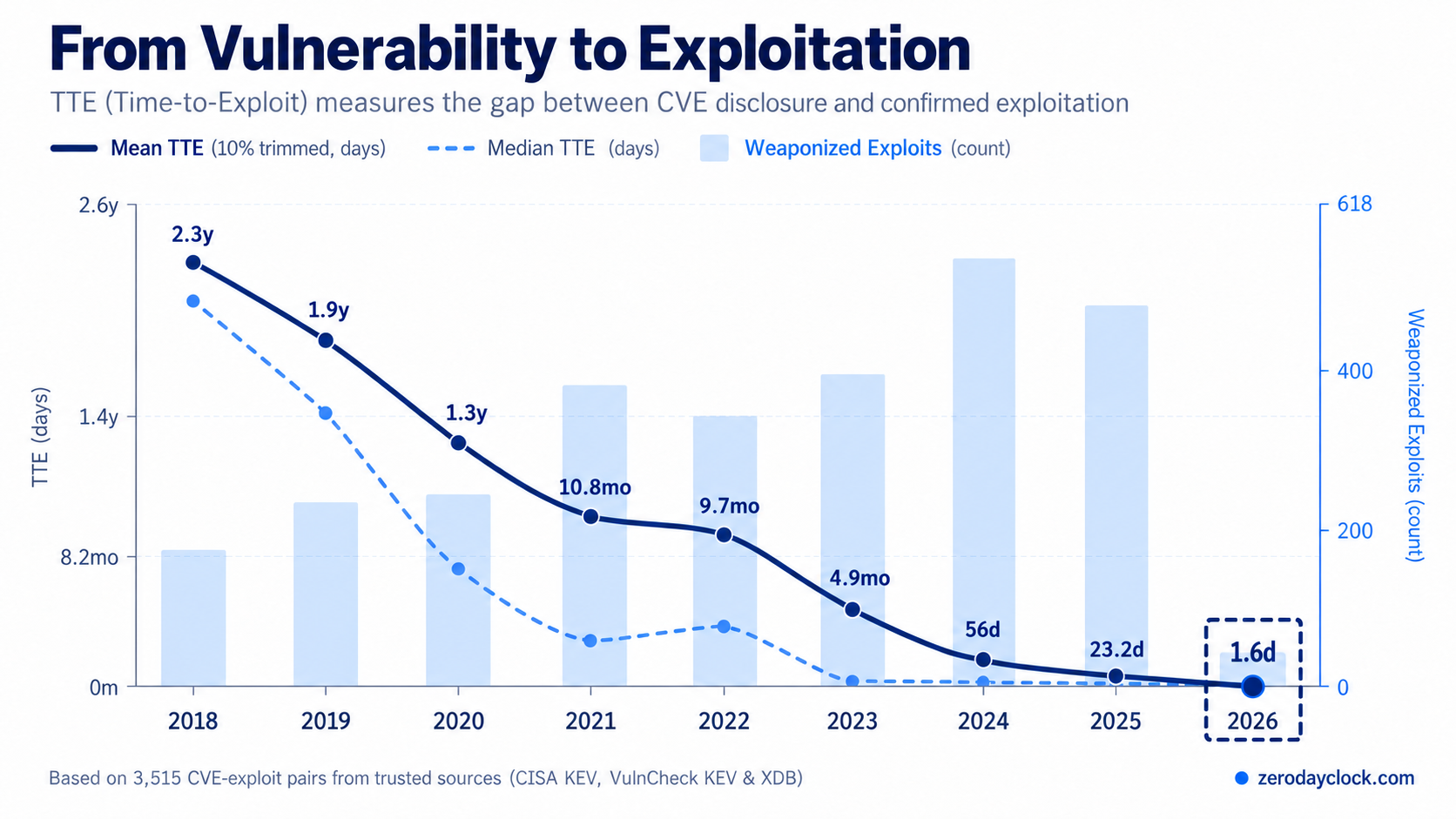
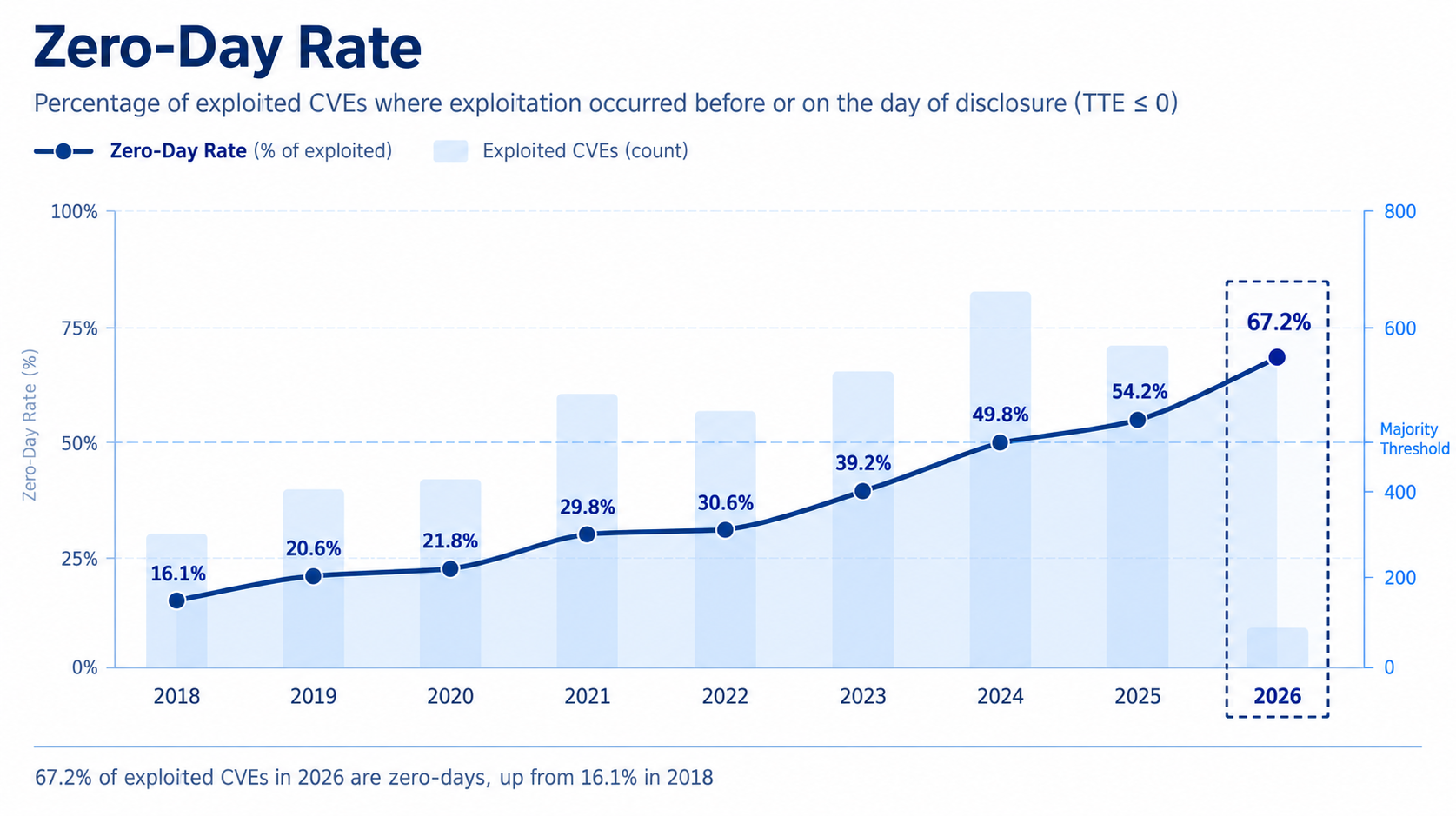
Another trend that the team at Zero Day Clock has noticed is a dramatic increase in the share of vulnerabilities exploited before or on the day they are disclosed, rising from 16.1% in 2018 to 67.2% in 2026. This means nearly seven out of ten exploited vulnerabilities now provide organizations with little or no advance warning, reinforcing the need to shift from traditional patching cycles to continuous visibility, rapid remediation, and automated security operations.
Frontier models (like Mythos) can analyze large volumes of source code and software packages at machine speed. The same capability that helps defenders identify weaknesses can help adversaries automate discovery and weaponization. Meanwhile, security teams must determine whether the organization is affected, understand the business impact, obtain a trusted fix, test it, and deploy it across complex production environments.
“ The strategic risk is the widening gap between the speed of the threat and the speed of the enterprise response. ”
Adding more alerts does not close that gap. In fact, finding more vulnerabilities without increasing remediation velocity can make the operating problem worse. The meaningful measure is not vulnerability volume. It is the elapsed time from validated exposure to secured production deployment.
Cybersecurity is now an executive operating responsibility.
Governments and regulators are raising expectations for cyber risk management, incident reporting, software integrity, and executive accountability. Boards increasingly need evidence that leaders understand material cyber risks and that appropriate controls, decision processes, and response capabilities are operating in practice. Here is a small subset of new regulations released in different countries:
- European Union:
- NIS2 Directive
- Cyber Resilience Act (CRA)
- United States
- SEC Cybersecurity Disclosure Rules
- Cyber Incident Reporting for Critical Infrastructure Act
- United Kingdom
- Cyber Security and Resilience Bill
- Canada
- Bill C-26 (Critical Cyber Systems Protection Act)
- Australia
- APRA CPS 234
- Japan
- Cybersecurity Management Guidelines
- Economic Security Promotion Act
This expectation now reaches beyond infrastructure. Enterprises must understand the origin, integrity, and risk of the components inside their software, including open source libraries, containers, build artifacts, and AI-related dependencies. They also need governance across the AI lifecycle, with clear controls for security, transparency, provenance, and operations.
This makes cybersecurity a business resilience issue. A technically correct security strategy that cannot be executed at enterprise scale is not effective. Leadership must treat remediation capacity, platform consistency, software delivery capability, and cross-functional accountability as part of the control environment.
Why another security tool is not enough.
Most organizations already understand the outcomes they need. The difficulty is building the capability to achieve them consistently. The barriers usually appear across four interconnected dimensions:
- People: Security and operations teams are at capacity, while the required expertise keeps expanding.
- Process: Manual handoffs, fragmented workflows, and slow change controls make remediation difficult to scale.
- Organization: Security, development, and operations often work through different priorities, governance structures, and decision paths.
- Technology: Legacy platforms, inconsistent configurations, technical debt, and expanding dependency graphs slow execution.
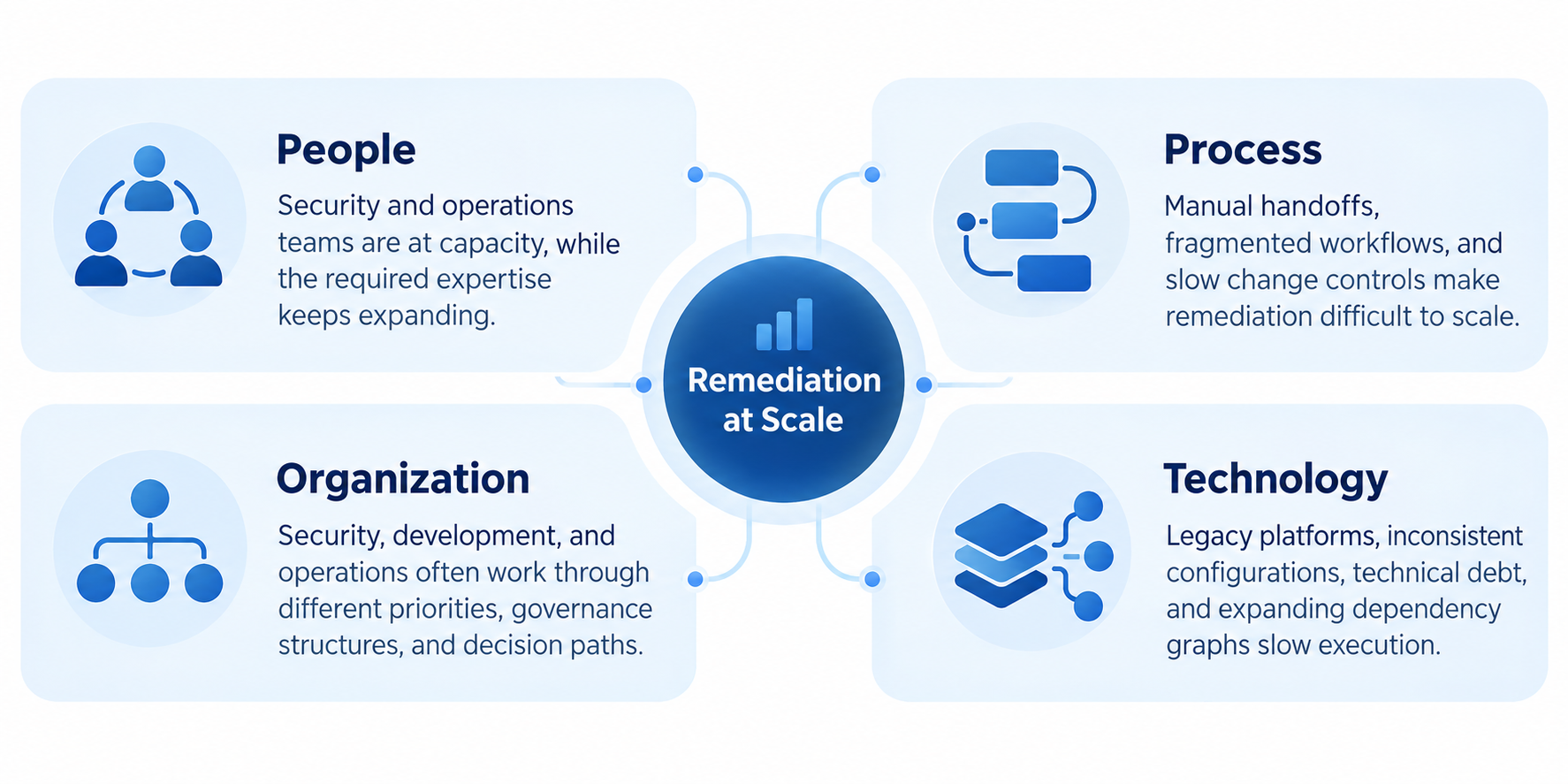
AI increases pressure across all four dimensions. A new point solution may improve visibility, but it cannot compensate for fragmented operating models, inconsistent platforms, or delivery pipelines that take weeks to move a trusted fix into production.
Three capabilities define readiness.
Organizations prepared for this new era will build three mutually reinforcing capabilities.
Accelerate response
A vulnerability alert is only the beginning. Teams must assess relevance, prioritize according to business risk, obtain or produce a trusted remediation, and deploy it quickly. The target should be response in hours or days, supported by automation and clear risk-based decision paths.
Increase agility
Security cannot become a permanent brake on innovation. Development teams need secure dependency management, reproducible builds, automated testing, policy controls, progressive delivery, and reliable rollback. These practices allow the organization to rebuild and redeploy affected applications quickly without abandoning governance.
Scale secure operations
Success cannot depend on a few experts or one-time remediation efforts. Enterprises need standardized operating environments, automated patching and deployment, continuous configuration management, and repeatable controls across the estate.
Secure the full journey from source to production.
Modern software is assembled as much as it is written. Applications depend on open source packages, frameworks, containers, build systems, repositories, CI/CD pipelines, and artifacts produced by multiple teams and suppliers. A major industry push has focused on securing application code or the production runtime, which matters, but leaving much of the attack surface unaddressed does not solve the whole security problem.
The first requirement is trusted software input:
- known sources
- transparent dependencies
- timely security intelligence
- and accelerated access to fixes
But the availability of a trusted fix does not automatically reduce risk. The modern enterprise must still locate the affected component, identify the applications that use it, evaluate business criticality, update the dependency, rebuild the software, validate the change, and deploy it safely.
“ The decisive question is: can your organization deploy a trusted fix as quickly as it becomes available? ”
A practical technical operating model.
After talking to organizations that have been successful in their evolution journey in the age of AI, a common pattern emerges: a durable response combines three technical domains.
- Platform security
- Standardize operating systems, cloud environments, container platforms, and infrastructure across the enterprise to reduce unnecessary variation and establish consistent operating models.
- Apply hardened configurations and security baselines as code.
- Automate patching and vulnerability remediation across all platforms.
- Use continuous configuration management and drift detection to maintain trust as applications, infrastructure, and operational requirements evolve.
- Software delivery velocity
- Standardize development environments and dependency management. Create reusable service blueprints.
- During the build stage, automate build management, security and quality checks, and policy enforcement to produce reproducible outcomes.
- For deployment, implement automated release management, progressive rollouts, rapid rollback, and repeatable patterns that work across the enterprise.
- Measure lead time, deployment frequency, failed change rate, recovery time, and developer onboarding time.
- Software supply chain security
- Begin with a complete inventory of software, dependencies, tools, and delivery processes.
- Baseline the security posture and prioritize risk.
- Strengthen source repositories and pipelines, reduce attack surfaces, and embed governance through policy as code.
- Before production, verify provenance, digital signatures, attestations, vulnerability status, and compliance evidence.
The leadership agenda.
Security in the age of AI requires a continuous operating model, not a one-time transformation. Every executive should ask:
- [ ] How long does it take us to determine whether a newly disclosed vulnerability affects the business?
- [ ] How quickly can we move from vulnerability identification to a verified fix deployed across every affected environment?
- [ ] Can we trace critical software components to every application and production environment that consumes them?
- [ ] Where do manual approvals, fragmented ownership, or platform inconsistencies extend the threat window?
- [ ] Are our teams building repeatable organizational capability, or relying on a small number of experts?
- [ ] Is our remediation cycle faster than the expected Time to Exploit, or does the vulnerability remain exposed after attackers can weaponize it?
The competitive advantage is resilience.
The organizations that succeed will not necessarily be those that deploy the most security tools. They will be those that connect trusted security intelligence to standardized platforms, automated delivery, and accountable decision-making.
In this environment, resilience becomes a competitive capability. Faster remediation reduces exposure. Consistent platforms reduce operational complexity. Secure delivery practices allow innovation to continue without weakening governance. Software provenance creates confidence with regulators, customers, and partners.